
The G20 can say what it wants on the crypto regulations front. It’s not a threat to the ecosystem, says Noelle Acheson.
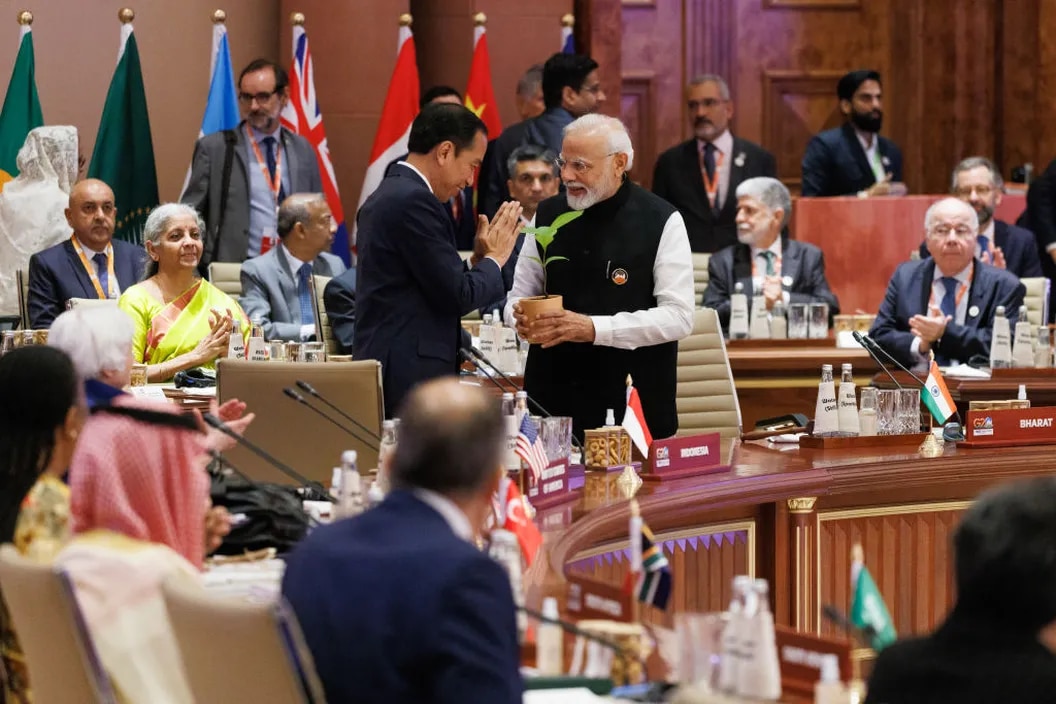
:format(jpg)/cloudfront-us-east-1.images.arcpublishing.com/coindesk/V7DPTXIZJNA7NGGA3WHGRHPMOU.jpg) Joko Widodo President of Indonesia presents Prime Minister Narendra Modi of India a tree sapling at the G20 on September 10, 2023 (Dan Kitwood/Getty Images).
Joko Widodo President of Indonesia presents Prime Minister Narendra Modi of India a tree sapling at the G20 on September 10, 2023 (Dan Kitwood/Getty Images).
This weekend kicked off the G20 summit in India, which will apparently deliver a group agreement on the need for stricter global regulation on crypto assets, according to a report Sept. 6 in The Hindu.
Noelle Acheson is the former head of research at CoinDesk and Genesis Trading. This article is excerpted from her Crypto Is Macro Now newsletter, which focuses on the overlap between the shifting crypto and macro landscapes. These opinions are hers, and nothing she writes should be taken as investment advice.
NOW
PLAYING
Federal Reserve Begins New Program for Overseeing…
Why this matters
On the one hand, this is a big deal in that key global regulators are working at constructing a coordinated framework for crypto regulation. This acknowledges an acceptance of three key features of crypto assets:
1 – they are global: a bitcoin in Bengaluru is exactly the same as a bitcoin in Seattle.
2 – they can cross borders without detection: the impact on capital flows understandably triggers a desire to monitor this, hence the drive for cooperation.
3 – they are here to stay: banning them is no longer an option, so, from the authorities’ point of view, control is the next best thing.
On the other hand, the parties behind the initiative highlight some fractures underlying the apparent cohesion, as well as the shifting allegiances of global politics. This makes the fuss and the focus more noise than substance.
India
Let’s start with India, which has long been calling for global coordination on crypto regulation. When it assumed the presidency of the G20 in December of last year, it made crypto coordination one of the key goals of its mandate and statements made throughout the year have reiterated this focus.
But India is not exactly crypto-friendly.
As crypto markets developed, trading became such a popular activity that the Reserve Bank of India (RBI), the country’s central bank and financial regulator, felt compelled to issue regular warnings about the risks of crypto asset trading (one from 2013 even mentions dogecoins).
Read more: India Will Decide on Its Crypto Stance in Coming Months
In 2018, the RBI went further and issued a circular prohibiting banks from offering services to “any individual or business entities dealing with or settling virtual currencies.” In 2020, India’s Supreme Court overturned this circular, and in 2021, the RBI issued a statement stressing that banks could service virtual currency companies as long as they carry out the required due diligence.
Banks have nevertheless been reluctant to engage with crypto services, presumably out of fear of attracting the attention of their regulator which they know disapproves of the activity. This is similar to the situation in the U.S.: servicing crypto companies is not illegal, but the powers-that-be don’t like it, and the corresponding revenue is not enough to compensate for the risk of additional scrutiny. Banks generally do not want to get on the wrong side of their regulators – that often turns out to be expensive.
What’s more, in early 2022, India imposed a 30% tax on all crypto income and trading profits, double that of the standard capital gains tax. This is even more punitive than it may seem, as the income is not considered on a net basis. Losses in one asset cannot offset gains in another. Nevertheless, it conferred a certain legitimacy on crypto activities – if the government is taxing it, it can’t be illegal, right?
The country’s banking regulator still did not seem to agree, however. In the same month, it reiterated its conviction that crypto assets should be banned, with the deputy governor calling them “worse than Ponzi schemes,” and the governor saying that they were “not even a tulip” (ouch).
The central bank is just one arm of the government and does not speak for the Finance Ministry, but the tone is obviously not supportive, which imbues the calls for global regulation with a hint of reluctance.
G20
Moving on to the G20 itself, its pronouncements and agreements are significant but not binding. It has no regulatory authority, and its legitimacy is conferred by the standing of its members. This is shifting.
First, many assume that the group represents the world’s 20 largest economies. This is not so. Most members are in the top 20, but not all, and some economies that are in the top 20 have been left out.
Spain, for instance, is the world’s 15th largest economy in terms of GDP. It’s not a member. It has representation via the EU, but so do France and Germany which also have individual membership. Spain is a “permanent guest,” but that’s not the same. Netherlands (17th) is also not a member. Nor is Switzerland (20th), even though its economy has a higher GDP than Argentina’s, which is. South Africa (39th) is a member, but Nigeria and Egypt, both of which are larger in terms of GDP, are not.
Apparently, the membership list was decided back in 2008 by deputies from Germany and the U.S., who added countries beyond the original G8 according to whose development they wanted to help “guide.” Membership has not changed since then, even though economic weight has.
Read more: G20 Set to Crystalize Global Crypto Rules as India Wraps Up Presidency
Last Thursday, it was announced that the African Union will become an official member as of 2024, in theory giving voice to its 55 states. While it made no sense for such a key economic region to be represented by only one country (South Africa), the African Union doesn’t exactly speak with one voice, so it’s not clear how beneficial this will be.
As for internal support, all member nations are sending representatives to attend what looks like a packed agenda, but China’s premier Xi Jinping is giving it a miss, even though he wouldn’t have far to travel. He did find it worth his time to cross a couple of continents to attend the recent BRICS summit in South Africa. Putin is also not attending, for obvious reasons.
Externally, some have called the G20 “multilateralism of the big.” And an article in the New York Times last week highlights the futility of many recent G20 initiatives. In the 2021 Rome summit, for example, a pact was reached to limit global warming with, among other measures, a pledge to end the financing of coal power plants overseas. Glossing over how “colonial” this sounds (what does “overseas” mean?), last year coal-fired power generation reached an all-time high according to the International Energy Agency, a record that looks set to be beat this year.
So, let’s assume that we get some firm statements from the group in support of the Financial Stability Board’s (FSB’s) latest policy recommendations, published in July. That’s very likely, since the recommendations don’t actually say anything interesting. There’s a smattering of “authorities should have the appropriate powers,” apply regulation, cooperate with each other and require crypto asset service providers to manage their risk carefully, and not much else. I mean, all that sounds fair, but to this interested observer, there seems to be a lot of noise about nothing.
True, the recommendations do urge tighter regulation than many regimes (such as the U.S.) have in place at the moment. Let’s assume that this is taken as an imperative: will China conform? Will Argentina? Will all African Union member states? Will the EU be willing to adapt its hard-won MiCA framework to conform with a direction guided by a very different political and economic system (that of India)? And beyond the G20 (or is it now the G21?), does Barbados care? Tuvalu?
The theory is that they all will if they want to maintain their seat at the table, and/or friendship with those who have one. But who decides if a nation should be kicked out? Russia is still a member, and it can be argued that invading another country is more cause for censure than not adopting certain financial regulations.
And, there are now alternatives. The BRICS alliance has just more than doubled its membership. Other blocs are also busy.
What’s more, the G20 focus is about to change, and with it, perhaps the pressure for that elusive global coordination. There are less than three months left in India’s G20 presidency.
Brazil takes over in December, and its regime has so far been much more supportive of crypto markets. The country already has a regulatory framework for cryptocurrencies, a crypto exchange is participating in CBDC trials with the central bank, banks connect with crypto platforms, spot crypto ETFs have been trading on stock exchanges for over two years, and the country’s largest public bank allows the payment of taxes in cryptocurrency. In many, many ways, Brazil is not India, and it is likely to steer the G20’s focus in another direction.
So, we will probably see a lot of hand-wringing over the restrictive nature of whatever agreement emerges, but none of it will matter much.
Story continues below
Recommended for you:
There is upside to this. Discussions are important, if only to clarify situations and priorities. And we now have pretty close to a global consensus that attempting to ban crypto is futile. So, we can let the G20 do what it wants on the crypto regulations front. It’s not a threat to the ecosystem, even if it does recommend stricter disclosure rules than many would like. Rather, it takes steps to further legitimize crypto assets and their markets, and subliminally acknowledges that its influence in this field is limited.
Edited by Ben Schiller.
Newsletter Every Weekday
Sign up for The Node, our daily newsletter bringing you the biggest crypto news and ideas.
Enter your Email
By clicking ‘Sign Up’, you agree to receive newsletter from CoinDesk as well as other partner offers and accept our terms of services and privacy policy.
Learn more about Consensus 2024, CoinDesk’s longest-running and most influential event that brings together all sides of crypto, blockchain and Web3. Head to consensus.coindesk.com to register and buy your pass now.
DISCLOSURE
Please note that our privacy policy, terms of use, cookies, and do not sell my personal information has been updated.
The leader in news and information on cryptocurrency, digital assets and the future of money, CoinDesk is a media outlet that strives for the highest journalistic standards and abides by a strict set of editorial policies. CoinDesk is an independent operating subsidiary of Digital Currency Group, which invests in cryptocurrencies and blockchain startups. As part of their compensation, certain CoinDesk employees, including editorial employees, may receive exposure to DCG equity in the form of stock appreciation rights, which vest over a multi-year period. CoinDesk journalists are not allowed to purchase stock outright in DCG.
Noelle Acheson
Noelle Acheson is the former head of research at CoinDesk and Genesis Trading. This article is excerpted from her Crypto Is Macro Now newsletter, which focuses on the overlap between the shifting crypto and macro landscapes. These opinions are hers, and nothing she writes should be taken as investment advice.
Credit: Source link