
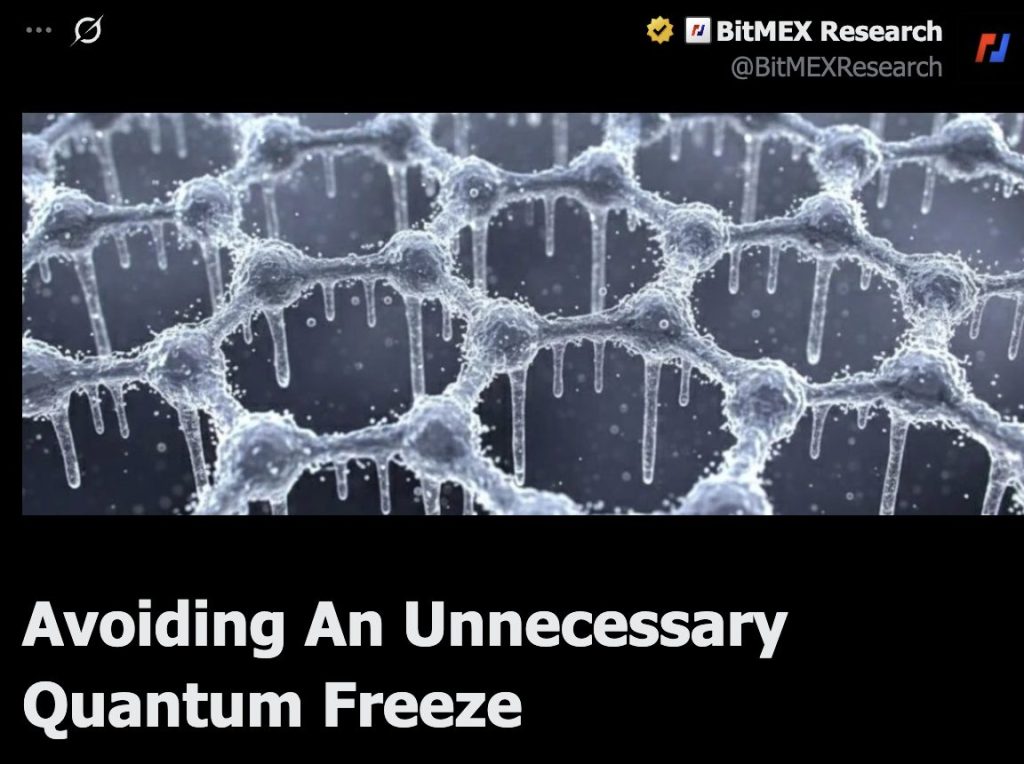
BitMEX Research has proposed a ‘quantum canary fund’ mechanism for Bitcoin that would trigger a coin freeze only if a quantum computing threat is demonstrably real, positioning the idea as a direct counter to BIP-361’s preemptive forced-migration approach.
The proposal lands in the middle of an active governance fight over how Bitcoin should respond to quantum risk, and whether protocol-level coercion is ever justified to protect user funds.
The question isn’t whether quantum computers will eventually threaten ECDSA signatures. It’s who gets to decide when that threat is actionable, and what the protocol is allowed to do about it.
- Proposal: BitMEX Research has put forward a quantum canary fund as an alternative mechanism for protecting Bitcoin against quantum computing threats.
- Trigger condition: The canary fund activates a coin freeze only if a verified quantum threat materializes – not preemptively, unlike BIP-361’s phased approach.
- Canary mechanics: A designated address uses a Nothing-Up-My-Sleeve Number (NUMS) system to generate a provably unknown private key, monitored on-chain via soft fork for signs of quantum exploitation.
- Safety window: A 50,000-block delay – roughly 345 days – follows any canary trigger before a full freeze activates, giving legitimate holders time to migrate.
- What it responds to: BIP-361, merged into the Bitcoin Improvement Proposal repository on April 15, 2026, proposes banning sends to quantum-vulnerable addresses within three years and freezing legacy coin spends within five years of activation.
- Trade-off acknowledged: BitMEX concedes the canary mechanism adds complexity and introduces its own risks, but argues it is preferable to BIP-361’s disruption of Bitcoin’s immutability guarantees.
- Community fault line: Jameson Lopp’s BIP-361 drew sharp criticism for preemptively restricting legitimate funds; Adam Back has advocated optional upgrades over mandatory freezes.
- Watch: Whether BitMEX formalizes the canary fund as a counter-BIP and whether it draws engagement on the Bitcoin developer mailing list – that activity will signal whether this proposal moves from concept to contention.
Discover: The best pre-launch token sales
How the Canary Fund Mechanism Actually Works – and What It Doesn’t Protect
The canary fund concept centers on a specially constructed Bitcoin address whose private key is provably unknown to anyone.
Using a Nothing-Up-My-Sleeve Number (NUMS) system, the address is generated on the elliptic curve in a way that no party, including its creators, can control.
A soft fork marks this address for on-chain monitoring, turning it into a live tripwire: if funds ever move from it, that movement proves a quantum computer has cracked ECDSA in practice, not just in theory.
That is not the same as quantum-proofing Bitcoin. The canary fund does not upgrade any existing wallet, does not migrate any exposed public keys, and does not protect coins that were already at risk the moment their public keys appeared on-chain.
What it does is delay the most disruptive protocol intervention, a coin freeze – until there is verifiable on-chain evidence that the threat is real and active.
The 50,000-block safety window built into the proposal (approximately 345 days) is deliberately structured as an incentive, not just a grace period.
BitMEX’s reasoning: if a quantum-capable actor can crack the canary address, competitors with similar capabilities would face the same temptation across thousands of exposed addresses.
The race-to-claim dynamic theoretically surfaces the threat before it propagates silently. The complexity cost is real – the canary system requires soft fork coordination, on-chain monitoring infrastructure, and a community-wide consensus on what constitutes a valid trigger. BitMEX acknowledges this openly.
Discover: The best crypto to diversify your portfolio with
The Governance Debate the Canary Fund Sits Inside
BIP-361, authored by Jameson Lopp and merged into the Bitcoin Improvement Proposal repository on April 15, 2026, represents the most structured protocol-level response to quantum risk currently in circulation.
Its Phase A bans new sends to quantum-vulnerable addresses three years after activation. Phase B, two years later, invalidates all legacy signatures, freezing any unmigrated coins outright.
A speculative Phase C proposes zero-knowledge proofs linked to seed phrases for limited recovery, though feasibility remains unresolved.
The backlash was immediate and predictable. Critics argued BIP-361 violates Bitcoin’s core property-rights guarantees by preemptively restricting funds that have not been compromised.
Adam Back’s position, that Bitcoin must prepare for quantum risk through optional upgrades rather than coercive protocol changes, reflects the dominant skeptic view. The quantum security debate has been intensifying alongside broader market attention to Bitcoin’s long-term cryptographic assumptions.
BitMEX’s canary fund attempts a third path: evidence-based intervention rather than precautionary freezing.
It preserves the status quo until the threat becomes empirically demonstrable, which satisfies the ‘your keys, your coins’ objection, until the canary trips, nothing changes.
The trade-off is that it provides no protection during the window between when a quantum adversary first achieves cryptographic capability and when they choose to trigger the canary.
That gap could be exploited silently. The question isn’t whether the canary fund is philosophically cleaner than BIP-361. It’s whether ‘wait for proof’ is an acceptable risk posture given that Google and Caltech research suggests quantum breakthroughs may arrive ahead of prior estimates. Other major blockchains, including Tron, are already building out quantum roadmaps without waiting for on-chain confirmation of a threat.
The post BitMEX Proposes ‘Canary Fund’ Alternative in Bitcoin Quantum-Security Debate appeared first on Cryptonews.
Credit: Source link