
Arthur Hayes argues that the next leg of the crypto cycle will be driven not by a headline pivot to quantitative easing, but by a “stealth” version executed through the Federal Reserve’s Standing Repo Facility (SRF). In a new essay titled “Hallelujah” published on November 4, 2025, the former BitMEX CEO lays out a balance-sheet-driven case that persistent US fiscal deficits, hedge-fund demand for Treasuries financed via repo, and the Fed’s need to cap funding stress will translate into incremental dollar liquidity that ultimately “pumps the price of Bitcoin and other cryptos.” As he frames the core mechanism: “Government issued debt grows the money supply.”
Hayes’ logic chain begins with an observation on political incentives and the arithmetic of public finance. Governments can fund spending with “savings or debt,” and in his view elected officials “will always favor borrowing from the future to get re-elected in the present.” For the United States, he contends that the trajectory is already set: “Here are the estimates from the TBTF banksters, and a few US government agencies. As you can see, the estimates are for ~$2 trillion deficits funded by ~$2 trillion of borrowing.” In his model, once one accepts that “Yearly Federal Deficit = Yearly Treasury Debt Issuance Amount,” the next critical question is who actually buys that debt, and on what financing.
Fed’s Stealth QE Will “Pump Crypto”
He dismisses foreign central banks as dependable marginal buyers after the US sanctioned and immobilized Russian reserves in 2022. “If Pax Americana is willing to steal Russia’s money… then no foreign owner of treasuries is ever safe,” he writes, concluding reserve managers “would rather buy gold than treasuries.” He likewise downplays the capacity of the US household sector given that “the 2024 personal savings rate was 4.6%” while “the US federal deficit was 6% of GDP,” and he argues the largest US money-center banks have increased their Treasury holdings by only “~$300 billion” in fiscal 2025 against issuance of “$1,992 billion,” making them meaningful but not decisive.
Related Reading
Instead, Hayes positions relative-value hedge funds—particularly those booking positions via Cayman vehicles—as the marginal, price-setting bid for US duration. Citing a recent Federal Reserve study, he quotes: “Cayman Islands hedge funds purchased, on net, $1.2 trillion of Treasury securities… [between] January 2022 and December 2024… [and] absorbed 37% of net issuance of notes and bonds.” The trade architecture is straightforward: “Buy a cash treasury debt security vs. sell the corresponding treasury futures contract,” then lever the tiny basis through repo funding. Because the edge is “measured in basis points,” the trade only works if leverage is cheap and predictable every day.
That funnel leads directly to the SRF. Hayes lays out the Fed’s short-rate corridor—“Upper and Lower Fed Funds; currently these equal 4.00% and 3.75% respectively”—and the policy plumbing that keeps market rates inside it: the Reverse Repo Facility (RRP) at the lower bound for money-market funds (MMFs) and banks, interest on reserve balances (IORB) for banks in the middle, and the SRF at the upper bound as the emergency spigot.
Lower Fed Funds = RRP < IORB < SRF = Upper Fed Funds,” he summarizes, adding that the target, SOFR, normally oscillates inside the band. Stress occurs “when SOFR trades above the Upper Fed Funds,” which he calls “a problem” because “the filthy fiat financial system shuts down” once participants can’t roll overnight leverage at a stable rate.
In his telling, the cash supply that cushions SOFR is structurally thinner than it was when the Fed began quantitative tightening in early 2022. MMFs, he says, have drained the RRP to zero because “the T-bill rate is so attractive,” making them less available as repo cash providers. That leaves banks, who will supply liquidity so long as they have ample reserves, but “banks lost trillions in reserves since the Fed began QT.”
Set against that diminished supply of cash is relentless demand for repo financing from RV funds, whose “marginal” Treasury purchases must be levered. If SOFR threatens to pierce the ceiling and repo becomes unreliable, the Fed’s SRF must backstop the system to prevent a funding accident. “Because a similar situation occurred in 2019, the Fed created the SRF,” Hayes writes. “The Fed can supply an infinite amount of cash using its printing press at SRF as long as one provides an acceptable form of collateral.” His conclusion is blunt: “If the SRF balances are above zero, then we know the Fed is cashing the checks of the politicians using printed money.”
Hayes labels this dynamic “Stealth QE.” He argues the optics of outright balance-sheet expansion via asset purchases are now politically toxic—“QE is a dirty word… QE = money printing = inflation”—so the central bank will prefer to meet marginal dollar demand via SRF lending rather than by visibly creating excess reserves.
What This Means For The Crypto Market
The result is functionally similar from a liquidity standpoint, in his view: repo credit distributed by the Fed against Treasuries still increases spendable dollars in the system to finance government borrowing. “This will buy some time, but eventually the exponential expansion of treasury debt issuance will force the repeated use of the SRF,” he writes. “Stealth QE will begin shortly. I don’t know when it will begin. But… the SRF balance must grow as the lender of last resort. As SRF balances grow, the amount of fiat dollars in the world expands as well. This phenomenon will reignite the Bitcoin bull market.”
He also sketches a near-term tactical backdrop that helps explain recent market tone across crypto. While auctions are pulling cash into the Treasury General Account, he notes, fiscal spending has been temporarily impeded by the government shutdown, producing a net drain in private-sector liquidity.
Related Reading
“The Treasury General Account is above the $850 billion target by ~$150bn,” he writes, arguing that this “extra liquidity won’t get released into the markets until the government reopens,” contributing to “current softness in the crypto markets.” In other words, the same fiscal engine that ultimately forces the Fed’s hand via the SRF can, in the very short run, sap liquidity when issuance front-runs outlays.
Hayes’ rhetoric remains intentionally sharp. He describes Treasuries as “dog shit” at prevailing real yields, calls the buy-side “debt shit eaters,” and opens with a hymn to Bitcoin’s monetary properties—“Praise be to Lord Satoshi that time and compounding interest exist regardless of who you are.” The provocation serves the point: if the marginal financing of US deficits increasingly relies on opaque backstops rather than transparent reserve creation, then crypto’s native, non-sovereign liquidity cycles will key off the same hidden plumbing. He distills the investment upshot in a single sentence: “Treasury Debt Amount Issued = Increase in Supply of Dollars.”
The essay is not a calendar call. Hayes refuses to timestamp the inflection—“I don’t know when it will begin”—and he warns that “between now and when stealth QE begins, one has to husband capital. Expect a choppy market,” especially with shutdown dynamics distorting flows.
But he is unequivocal on direction once SRF usage becomes persistent: “Stealth QE will begin shortly… [and] will reignite the Bitcoin bull market.” For crypto investors conditioned to watch CPI prints and FOMC dots, the message is to track money-market microstructure instead. In Hayes’ framework, when SRF balances stop being a rounding error and start trending, that is the tell that dollar liquidity has quietly flipped—and that crypto isn’t topping yet.
At press time, the total crypto market cap was at $3.41 trillion.
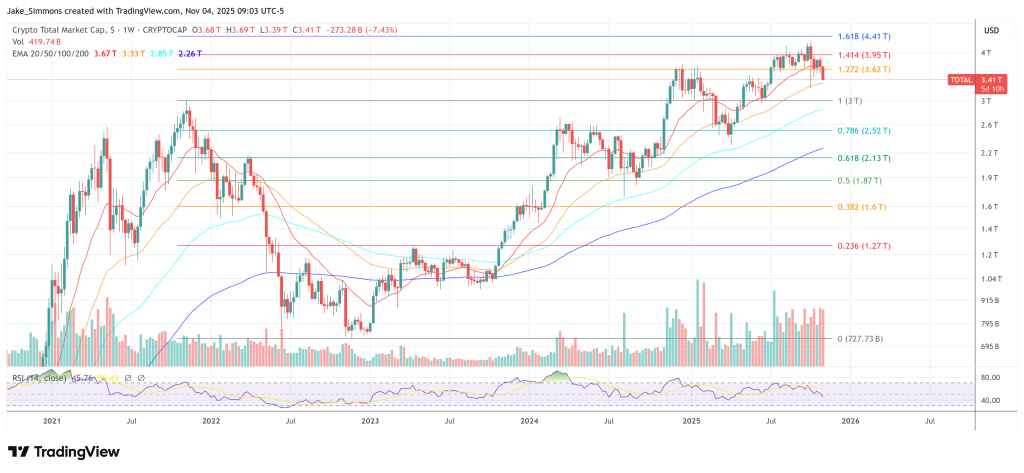
Featured image created with DALL.E, chart from TradingView.com
Credit: Source link