


A primary driver of the crypto sector is the escape from the central banking system. By electronically creating money ex nihilo to finance government spending, central banking consistently devalues fiat currencies through inflation.
In turn, it becomes more difficult to save money. Rather, such a system incentivises yield chasing via equities and other assets. With embedded scarcity and enforced proof-of-work security, Bitcoin emerged as the central banking remedy, maturing to an impressive $2.17 trillion market cap.
After exchange-traded funds (ETFs), another innovation emerged to provide exposure – Bitcoin treasuries. What are they and do they represent a threat to Bitcoin’s prospects?
Leveraging Bitcoin’s Scarcity
Unlike gold, whose value could be diluted with each new discovered vein, Bitcoin’s scarcity is deterministic, set at 21 million BTC. Bitcoin detractors often refer to the physical nature of gold as superior, yet it would be a mistake to paint Bitcoin as a purely digital asset. Bitcoin’s mainnet demands computing resources as hard assets, additionally fortified by dynamic mining difficulty.
If there were a market upheaval leading to the bankruptcy of large mining companies, the lowered hashrate would open the door for even more profitable mining for BTC block rewards. And increased hashrate would again ensure network security. It is precisely this design elegance – self-adjusting balance between profitability and network health – that keeps driving Bitcoin fundamentals.
Moreover, state actors cannot as easily seize Bitcoin as they could seize gold. In fact, most gold is held indirectly through federal reserves and financial products like ETFs rather than physically. Despite Bitcoin’s relative novelty, it is then easy to understand why it achieved such massive growth – over $2 trillion USD within merely 16 years.
It is also easy to understand why Michael Saylor’s MicroStrategy (rebranded to Strategy) has been so successful. Routinely, MSTR stock outperforms Bitcoin itself, as the company keeps accumulating more BTC. Over one year, BTC price ‘only’ grew by 92% while MSTR shares gained 217% more value.
MicroStrategy pushed this Bitcoin treasury blueprint to the forefront for others to follow:
- Issuing debt at favourable interest rates to buy appreciating Bitcoin with depreciating currency.
- The debt leverage, but without a margin call, multiplies MSTR stock value.
- As a publicly traded company, MicroStrategy gives institutional investors a way to gain exposure to Bitcoin without buying Bitcoin.
- In turn, MicroStrategy gets to buy more Bitcoin by selling MSTR shares. And buying more Bitcoin further increases its scarcity and value, again boosting MSTR stock in the process.
At this level of post-ETF maturity and first state-backed Bitcoin reserve in Texas, it is difficult to find Bitcoin’s structural weakness. It is a fully legitimised and institutionalised asset. Consequently, this dynamic translates into more companies building Bitcoin treasuries.
The Rise of Bitcoin Treasuries
Across 143 publicly traded companies, Bitcoin treasuries now account for 852,453 BTC. At the present price of Bitcoin at over $115k, this translates to approximately $98 billion USD. Moreover, privately-held companies picked up Bitcoin treasury steam, accumulating 290,884 BTC worth around $33 billion USD.
Sandwiched between public and private companies, 12 governments hold 527,656 BTC worth around $60 billion USD. Altogether across blockchain networks, exchanges, ETFs, governments and companies, Bitcoin treasuries hold 3.49 million BTC. At over $400 billion USD, this is just above the entire market cap of consumer health giant Johnson & Johnson (NYSE: JNJ).

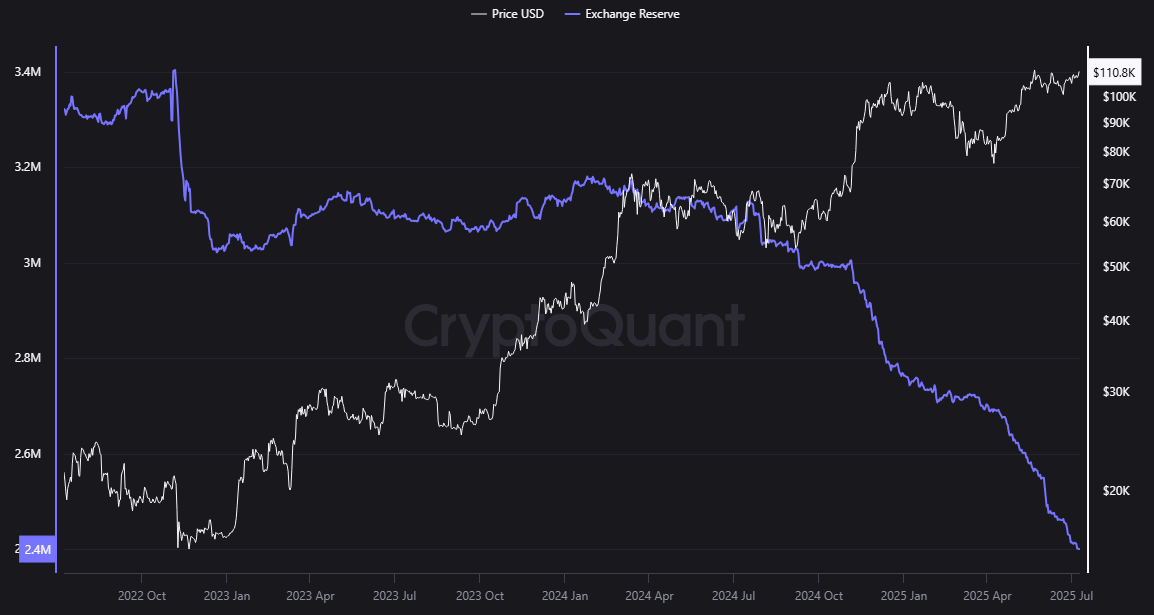
For comparison, in January 2024, these entities held 1,848,566 BTC, representing an 88% accumulation uptick. In the meantime, there is greater dearth of Bitcoin on exchanges, suggesting an imminent supply shock.
Nobody knows if this supply problem will be offset by the awakening of dormant whales to lock in profits. As of early July, long-term holders (LTH) took advantage of Bitcoin’s all-time high price while short-term holders (STH) absorbed the supply.
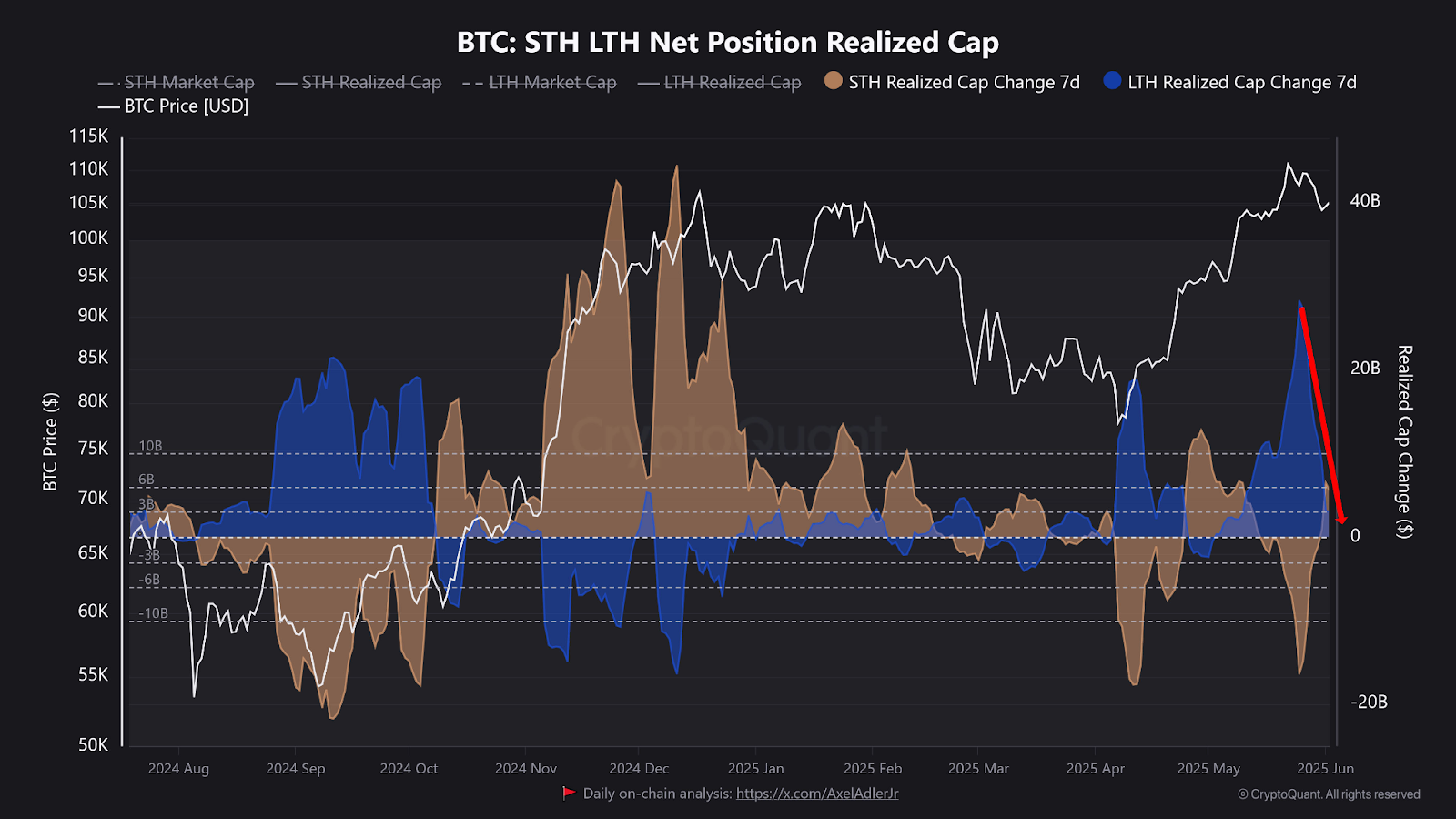
Whatever the dynamic may be at the moment, it goes against Bitcoin scarcity. However, with so many companies holding or launching Bitcoin treasuries, is this itself a potential selloff risk?
Risks to Bitcoin Treasuries Ecosystem
When GameStop (NASDAQ: GME) bought 4,710 BTC worth $513 million in late May, the company effectively expanded its liability portfolio. Although the gaming retail chain holds $6.4 billion USD in cash and cash equivalents as of Q1 2025, it remains uncertain if GameStop’s business model is viable in the age of digital distribution platforms.
With Bitcoin added to its balance sheet, GameStop can now use BTC as a collateral for short-term loans in order to fund operations. This may become a trend across a broad spectrum of companies.
Companies without GameStop’s cash reserves are even raising money to buy Bitcoin. Case in point, Tokyo-listed Remixpoint Inc. raised $215 million from creditors to hold 3,000 BTC in treasury – a far cry from short-term strategies like dividend capture, which aim to exploit timing windows for modest yield rather than speculative balance sheet risk.
Likewise, Swedish IT company H100 Group AB raised $54 million, now holding 247.5 BTC in total, representing nearly half of its assets. Even worse, small cap Mercurity Fintech (NASDAQ: MFH) announced plans to fundraise $800 million to build a Bitcoin treasury. The problem is, as of late 2024, the company had a negative free cash flow of $2.84 million and total liabilities worth $11.6 million.
This is all too reminiscent of the crypto boom in 2021 and the subsequent bankruptcy cascade of the sector throughout 2022. Effectively, many companies, including the largest holder MicroStrategy, are making Bitcoin a debt-based asset.
Japanese Metaplanet, headed by Simon Gerovich, already announced plans to collateralise its Bitcoin treasury holding 15,555 BTC for loans. After accumulating 210,000 by the end of 2027, Metaplanet then plans to proceed to phase two:
“Then we have phase two . . . when Bitcoin, like securities or government bonds, can be deposited with banks…and then they’ll provide very attractive financing against that asset,”
The ultimate goal would be to buy positive cash flow businesses with an appreciating but collateralised asset. However, the entire ecosystem would then depend on other companies making prudent decisions, which would essentially equalise Bitcoin exposure to the earnings race.
The Bottom Line
A decade ago, even the most bullish Bitcoin evangelists couldn’t have dreamed of Bitcoin’s present level of institutionalisation. However, this integration into the existing debt-based system is a move away from Bitcoin as peer-to-peer (P2P) money to replace fiat currencies and the central banking system.
Rather, it appears that Bitcoin is heading into the hedging direction for large business plans. This makes predicting Bitcoin’s future more difficult, as it becomes tied to hundreds and thousands of collateralisation decisions.
Nonetheless, it may very well be the case that the most aggressive BTC accumulators will strike digital gold. And if their competence in Bitcoin accumulation translates to collateralised business expansion, Bitcoin holders may ultimately emerge as winners in a digital evolution of financial assets.
Whatever lies ahead, it’s clear that early Bitcoin adopters recognised a structural shift before most others.
Credit: Source link





![[LIVE] Ethereum Price Developments, October 22: Live News and Price Updates as ETH Price Crashes to $3800](https://cryptoabc.net/wp-content/uploads/2025/10/eth.svg.svg+xml)