

Khushi V Rangdhol
Jun 14, 2025 21:06
SpaceX’s rockets are crucial for low-cost satellite launches and blockchain projects. Recent political tensions raised concerns about reliance on one provider.
A quick recap for readers
SpaceX supplies most of the low-cost launches that small satellites—and a growing list of blockchain experiments—depend on. NASA pays the company handsomely because its rockets and Dragon capsules now do work the Space Shuttle once handled. When political noise hinted in June that those contracts might be yanked, Web3 builders suddenly had a new risk to model: What happens to an “internet in space” if its favourite rocket goes offline?
How we got here
-
Seed funding that changed everything. In 2006 NASA awarded SpaceX US $396 million under its Commercial Orbital Transportation Services (COTS) programme. That cheque helped finish the Falcon 9 rocket and Dragon cargo ship, giving the United States an independent ride to the International Space Station (ISS) after the Shuttle was retired.
-
From taxi service to Moon lander. In 2021 NASA picked a version of Starship as the Artemis programme’s first human lunar lander—a deal initially worth US $2.9 billion, since topped up by about US $1.15 billion for a second mission.
-
Launch cadence equals low prices. Frequent flights let SpaceX sell “rideshare” slots for roughly US $6,000 per kilogram—a bargain rival rockets still chase.
The June 2025 flare-up—more smoke than fire
A late-night social-media spat between Elon Musk and former President Trump briefly produced talk of cancelling federal contracts; Musk even mused (in a now-deleted post) about “decommissioning Dragon.” NASA quickly confirmed no missions were being scrapped, and Musk walked the comment back. Nothing in writing changed, but for 48 hours the world saw how much of America’s—and Web3’s—orbital plan hangs on one private company.
Why blockchain projects need those rockets
-
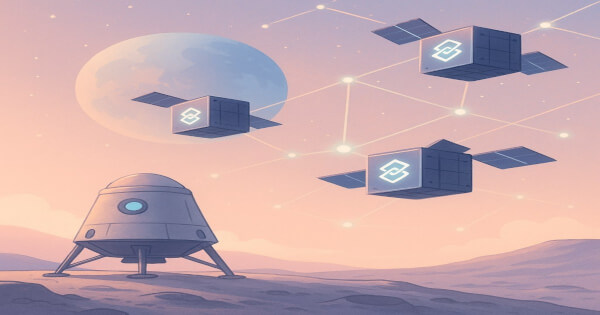
Tamper-proof ‘roots of trust’. Cryptosat launched its Crypto-1 and Crypto-2 nanosats on Falcon rideshares in 2022-23. They sit above every legal jurisdiction, signing data for DAO votes and zero-knowledge-proof applications.
-
In-orbit Ethereum nodes. SpaceChain has flown multiple payloads aboard Falcon 9 since 2019, most recently an Ethereum-compatible node deployed from the ISS.
-
Satellite beacons for on-chain data. Several start-ups piggyback on Starlink or small cubesats to broadcast Bitcoin price feeds and ensure NFT metadata can’t be censored.
All of them picked Falcon because it’s cheap, regular and (so far) the most reliable taxi to low-Earth orbit. Slow that taxi down and road-maps slip.
What really breaks if SpaceX–NASA relations sour?
-
Launch delays and higher prices. Alternatives exist—Rocket Lab, ISRO’s PSLV/SSLV, Arianespace’s Vega—but none match Falcon’s cadence or cost today.
-
Artemis knock-ons. A Moon delay is not just a flag-planting setback; deep-space logistics companies plan to test block-tokenised fuel depots and lunar-surface data relays.
-
Starlink-to-phone roll-out. Regulatory or budget trouble at SpaceX would also slow the first mass-market satellite internet service able to beam directly to ordinary smartphones.
How builders (and investors) can stay pragmatic
-
Plan B launch slots. Book secondary missions with ISRO or Rocket Lab early—even at a premium.
-
Build graceful fallbacks. Let orbital nodes feed mirrored servers on Earth so applications keep running if a satellite is late to launch.
-
Track budgets, not tweets. Real danger shows up first in NASA procurement documents and U.S. congressional hearings, not in viral threads.
The bottom line
For now, the SpaceX–NASA alliance is intact, Artemis hardware is still on the factory floor, and Falcon rideshares keep lifting CubeSats—blockchain or otherwise—into orbit. But last month’s drama was a useful stress test: Web3’s “space layer” is still fragile. Until the industry has two or three reliable, affordable rocket options, every tamper-proof satellite and orbital Ethereum node is, in a sense, flying standby on Musk’s schedule.
Take-away for non-specialists: if you own or build crypto projects that brag about “running in space,” keep one eye on NASA press releases and the other on back-up launch providers. The next frontier is exciting—but it still needs a ride.
Image source: Shutterstock
Credit: Source link