

Meta just handed Solana a corporate endorsement worth billions in narrative value. The social media giant has quietly rolled out USDC stablecoin payouts for creators on Solana and Polygon, and the crypto market is still processing what that news actually means for SOL’s price trajectory.
No verified 24-hour price spike has been confirmed yet, but the institutional signal is loud. Meta launched the program in Colombia and the Philippines on April 29, marking its first serious re-entry into stablecoins since the Libra collapse four years ago.
Stripe handles tax reporting; no fiat conversion is provided by Meta itself.
Polygon Labs CEO Marc Boiron called it directly: “The future of marketplace payouts is being built on blockchain infrastructure like Polygon,” adding that expansion to 160-plus countries is expected by year-end.
The broader US regulatory landscape around crypto payments and tax reporting adds another layer of complexity traders should watch.
Is Solana Price Positioned to Break Out on Meta’s Institutional Stamp News?
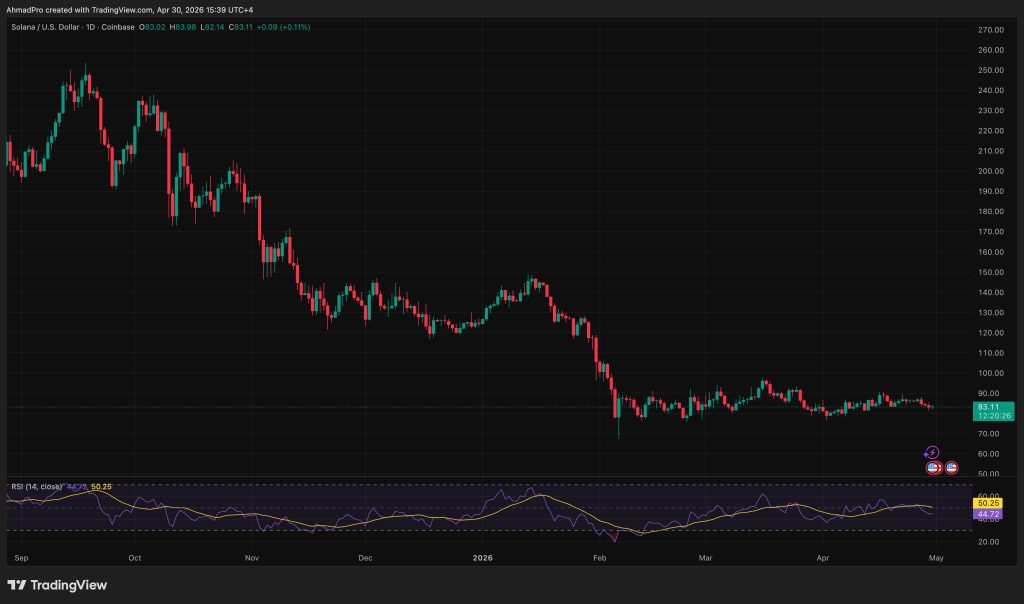
The Meta headline looks bullish on paper, but the chart is not confirming it. No breakout, no volume expansion, and price is still below key momentum levels, that matters more than sentiment.
Right now, SOL is in a fragile spot.
If the Meta narrative actually pulls in institutional attention, that is when price reclaims resistance at $90 and starts trending higher.
The risk is that broader skepticism spills over. If support at $80 fails, the setup turns bearish again and downside opens.
The key takeaway is simple, this is not a catalyst you chase. It is one you watch play out over time, because real impact depends on adoption, not announcement.
Bitcoin Hyper Eyes the Infrastructure Gap Meta Just Exposed
Meta choosing Solana highlights what actually matters now, speed and low latency are not optional anymore for real-world payments.
But that also raises the next question. If Solana is already being pushed as a base layer for these use cases, where does the next layer of performance and scalability come from?
That is where projects like Bitcoin Hyper are trying to position themselves. The idea is to build a Layer 2 on Bitcoin with SVM integration, bringing fast smart contract execution while keeping Bitcoin’s security.
The presale is already above $32.5M at around $0.0136793, which shows strong early demand. Features like staking, a native bridge, and low-latency execution are designed to support real usage rather than just narrative.
But it is still early, and that matters. Liquidity is untested, execution is not proven, and everything depends on delivery after launch.
So the shift is clear, Solana proves the demand for speed, while projects like Bitcoin Hyper are trying to capture the next layer of that narrative, with higher potential, but also higher risk.
VISIT Bitcoin Hyper HERE
The post Did Mark Zuckerberg Just Pick Solana? Meta Backs New Blockchains for USDC appeared first on Cryptonews.
Credit: Source link