

- Bitcoin’s hash rate dropped to approximately 920 EH/s, down roughly 8% over the past week, with a difficulty adjustment of about −8% expected on March 20.
- Rising crude oil prices are pressuring miners in energy-sensitive markets, while hash price hit an all-time daily low of US$27.89 PH/s/day in late February.
- Major public miners have collectively sold more than 15,096 BTC from peak holdings and are pivoting to AI and high-performance computing as Bitcoin margins remain compressed.
Bitcoin’s hash rate fell to about 920 EH/s this week, around 8% below the prior week, as lower miner profitability pushed more operators to sell BTC and redirect capital toward artificial intelligence infrastructure.
The decline is expected to trigger a downward difficulty adjustment of about 8% around March 20, lowering network difficulty from 145.04 trillion to 133.07 trillion. If that estimate holds, it would be the second-largest negative adjustment in five years. The drop follows a volatile period for the network. In February, difficulty first fell 11.16% on Feb. 7, then rose 14.73% on Feb. 19.
At the start of March, active hash rate was about 1,040 EH/s against an estimated installed ASIC capacity of 1,292 EH, leaving roughly 252 EH offline or curtailed. Compared with the roughly 1,100 EH/s peak reached in October 2025, the network is now down about 16% to 20%.
Read more: xAI Recruits Wall Street Experts to Train Grok for Finance
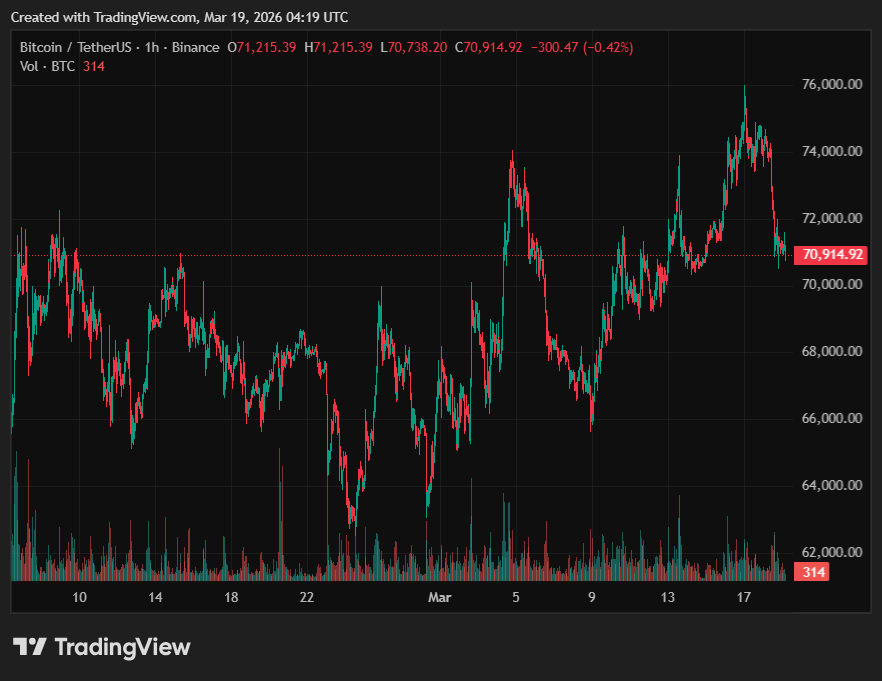
Bitcoin was trading below US$72,000 (AU$110K) on the same day, about 5% below its Monday high and far under the US$90,000 (AU$137K) level seen in late 2025.
Energy Prices and the Iran Conflict
Energy markets remain part of the backdrop. Brent crude rose to US$108.78 (AU$166) a barrel on March 18, up US$5.80 (AU$9) from the previous day and about 61% over the past month, as supply concerns linked to Iran and the Strait of Hormuz intensified.
Miner economics have weakened sharply. Hashprice, or daily revenue per unit of computing power, fell to a record low of US$27.89 (AU$43) per PH/s/day on Feb. 24. February’s average was US$32.31 (AU$49) per PH/s/day, down 17.9% from the previous month. Average network power cost is about US$50 (AU$77) per MWh.
Luxor Technology said the oil shock is more likely to hurt miners through weaker revenue than through electricity costs, noting that most global hash rate is based in markets where power prices are not closely tied to crude.
Large miners have responded by selling Bitcoin and funding AI expansion. Core Scientific cut holdings from 2,537 BTC to about 630 BTC and secured a US$500 million (AU$765 million) loan facility for AI and high-performance computing.
Bitdeer reduced its treasury from 2,470 BTC to zero and raised US$325 million (AU$497 million) for similar projects. Bitfarms cut holdings from 3,301 BTC to 1,827 BTC. MARA Holdings remained an outlier, holding 53,822 BTC while also expanding into AI data centers.
Read more: Bitcoin Rallies to $74.5K as ETF Inflows and Corporate Buyers Fuel Recovery
Credit: Source link